
Why Tire Pressure Affects Ride Quality More Than You'd Think
Jun 23rd 2026
We talk about suspension all day long. Spring rates, shock valving, ride height, travel, preload, geometry. If you've spent any time around us, you've probably heard us obsess over at least one of those topics.
But every now and then we get a message that goes something like this:
"I just installed a lift kit and the ride is terrible."
Our first question usually isn't about the shocks.
It's, "What tire pressure are you running?"
Not because tire pressure is more important than suspension. It isn't.
But because it's amazing how many ride quality complaints come down to a tire that's inflated like it's preparing for re-entry into Earth's atmosphere.
Your Tires Get First Crack at Every Bump
Before the spring compresses.
Before the shock starts moving.
Before your expensive suspension gets a chance to do anything.
The tire has already hit the bump.
Think of the tire as the first stage of your suspension system. Every pothole, expansion joint, washboard road, and chunk of broken pavement has to go through the tire before it reaches anything else.
If the tire is rock hard, it's going to send a lot more of that impact straight into the vehicle.
If the pressure is appropriate, the tire can absorb some of that energy before the suspension takes over.
That's also why bigger tires with taller sidewalls often ride better than low-profile tires. More sidewall and more air volume give the tire more ability to absorb small impacts.
Physics doesn't care whether the vehicle cost $20,000 or $200,000.
The Most Common Mistake We See
A surprising number of people use the maximum pressure listed on the tire sidewall.
Don't do that.
That's the tire's maximum rated pressure, not the pressure your vehicle necessarily wants to run every day.
The other common scenario is someone installs larger all-terrain tires, airs them up, and never thinks about them again.
Six months later they're convinced they need different shocks.
Meanwhile the tires are inflated to a pressure better suited for hauling a small moon.
A Few PSI Can Change Everything
People often underestimate how much difference tire pressure makes.
We're not talking about dropping from 40 PSI to 10 PSI.
We're talking about small changes.
Sometimes reducing pressure by 3-5 PSI can take a vehicle from feeling busy and choppy to feeling noticeably smoother over everyday roads.
Likewise, going too low isn't the answer either.
Steering gets slower.
Sidewalls flex more.
Heat increases.
Tire wear suffers.
Like most things in suspension, the answer is usually somewhere between the extremes.
Annoying, we know.
The Washboard Road Test
If you've ever driven on a heavily washboarded gravel road, you've probably experienced this firsthand.
The vehicle starts skipping around.
Your coffee develops its own suspension system.
Everything rattles.
The immediate reaction is usually, "These shocks are too firm."
Sometimes that's true.
But very often, a modest reduction in tire pressure will produce a larger improvement than people expect.
The tire starts conforming to the surface instead of bouncing across the tops of every ripple.
The ride improves.
Traction improves.
Your fillings stay where they belong.
Suspension Still Matters. A Lot.
Let's be clear.
We're a suspension company. It would be a pretty awkward article if we ended by telling you suspension doesn't matter.
A good suspension absolutely matters.
Tire pressure helps determine how impacts enter the vehicle.
Suspension determines what happens after that.
A properly designed suspension controls body motion, manages weight transfer, maintains traction, resists bottoming, and keeps the vehicle stable when the terrain gets rough or the speed starts climbing.
The best ride quality comes when both systems are doing their jobs.
A properly inflated tire feeding a properly designed suspension will almost always outperform either one trying to compensate for the other.
Start With the Free Stuff
Before replacing springs.
Before replacing shocks.
Before convincing yourself that your lift kit is the problem.
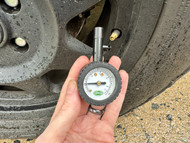
Grab a tire gauge.
Check your pressures.
You might discover that the fix costs exactly $0.
And if that doesn't solve it, then we can start talking about spring rates, shock valving, and all the expensive stuff we enjoy arguing about.