
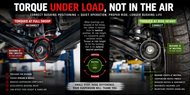
Why Suspension Components Must Be Torqued Under Load
Posted by Flatout Tech on Apr 10th 2026
The hidden cause of bushing bind, ride harshness, and post-installation noises
One of the most overlooked parts of suspension installation is when the final torque is applied to key suspension fasteners. Many installers focus on getting everything assembled correctly, but miss one critical detail: a large number of suspension components should not be final-torqued while the suspension is hanging at full droop.
This matters far more than most people realize.
Improper torque procedure can preload rubber bushings, distort their neutral position, reduce suspension compliance, create false spring effect, accelerate bushing wear, and generate the exact kinds of noises customers often describe as clunking, creaking, groaning, popping, or suspension harshness. In many cases, the shock or coilover gets blamed when the real issue is that the surrounding suspension pivots were locked down in the wrong position.
If a suspension component rotates through travel and uses a bonded rubber bushing, the final torque position is critical. Tightening it at the wrong suspension angle effectively twists the rubber at rest, and that creates problems immediately.
This article explains exactly why.
What “torquing under load” actually means
“Torquing under load” means final-tightening the relevant suspension fasteners with the vehicle’s suspension sitting at or near normal ride height, rather than while the wheels are hanging free.
That does not always mean the vehicle must be fully on the ground with zero access. In practice, it means the suspension should be supported so that the control arms, trailing arms, links, and other pivoting members are in their normal loaded position, or as close to it as possible.
The key idea is simple:
A suspension arm should be locked into place when it is sitting at its natural resting angle, not when it is hanging at maximum droop.
If you torque certain fasteners with the suspension fully extended, then lower the car onto the ground, the bonded rubber bushings are immediately forced to twist from that droop position to ride height and remain twisted all the time. That means the bushing starts life already under torsional stress before the car even moves an inch.
Why this happens: bonded rubber bushings do not rotate like bearings
To understand why torque angle matters, you first need to understand how most OEM-style suspension bushings work.
A typical bonded rubber bushing has three main parts:
- an outer shell pressed into the arm or mount
- an inner metal sleeve that the bolt passes through
- rubber bonded between the inner sleeve and outer shell
When the bolt is tightened, the inner sleeve is clamped solidly to the mounting tabs or chassis bracket. Once torqued, that inner sleeve does not freely spin on the bolt in normal operation. Likewise, the outer shell does not move because it is pressed into the component.
So where does movement come from?
The movement happens because the rubber itself twists as the suspension cycles up and down.
That means the rubber is designed to flex around a neutral installed position. If that neutral position is set wrong, the rubber is already wound up at static ride height.
Think of it like tightening a torsion spring while the arm is hanging, then forcing it into ride height and leaving it there permanently. The bushing is no longer centered in its operating range. It is biased from the start.
What goes wrong when bushings are torqued at full droop
1. The bushing is preloaded at ride height
This is the biggest issue.
When the suspension is hanging, control arms and links sit at a much steeper angle than they do when the vehicle is on the ground. If you fully tighten the pivot bolt in that drooped position, the inner sleeve is locked there. As soon as the vehicle is lowered, the arm rotates upward to ride height, but the inner sleeve cannot rotate with it. The rubber must absorb the difference by twisting.
So the bushing is now carrying torsional load just sitting still in the driveway.
That preload stays in the system at all times and changes how the suspension behaves.
2. The suspension develops artificial spring rate
A twisted rubber bushing resists movement. That resistance adds to the actual coil spring and damper forces. In other words, the suspension is no longer moving freely through its travel. The bushings are now contributing an unintended spring force.
This causes several negative effects:
- harsher initial movement over small bumps
- reduced suspension sensitivity
- less compliance over broken pavement
- increased ride stiffness that was never designed into the system
- inconsistent wheel rate through travel
In severe cases, the car can feel like it has far more low-speed resistance than it should, even if the dampers are set soft.
This is one reason a vehicle may feel surprisingly stiff or “bound up” after installation even when the shock settings and spring rates are correct.
3. Ride height can change or become inconsistent
Because the bushings are storing torsional energy, they can actually push back against the suspension and influence where it settles. That means the vehicle may not sit naturally at rest.
Possible symptoms include:
- a slightly elevated ride height
- corner-to-corner inconsistency
- the car not settling predictably after alignment or install
- strange changes after driving a short distance
Sometimes installers chase spring perch height trying to fix an uneven stance when the real issue is that one side’s bushings were locked in a more twisted position than the other.
4. Bushing life is shortened
Rubber bushings are designed to deflect within a certain working range. If the installed neutral point is wrong, the rubber spends its entire life under constant torsional strain, then is asked to twist even further during compression and rebound.
That leads to:
- accelerated fatigue
- tearing of the rubber bond
- splitting or cracking
- permanent deformation
- early noise development
A properly installed bushing flexes around its center. An improperly torqued one lives near one end of its range all the time. That is a major difference in durability.
5. Noises begin showing up that sound like bad shocks, bad mounts, or loose hardware
This is where a lot of confusion starts.
A preloaded or overstressed bushing can create all kinds of noise, especially once the rubber begins to bind, slip microscopically, or tear internally. The sound may not be a single obvious clunk. It can be:
- creaking while turning into driveways
- groaning over speed bumps
- popping during transitions
- chirping during small suspension movements
- a dull thud on compression or rebound
- binding sounds at low speed parking maneuvers
Customers often describe these noises as coming from the coilover, top hat, sway bar, or even steering rack because that is the part they just replaced. In reality, the source may be a control arm pivot, trailing arm bushing, lateral link bushing, or shock eye bushing that was locked down at the wrong angle.
Why some components care about torque angle and others do not
This is an important distinction.
Not every suspension fastener must be final-torqued under load. The procedure matters most for components that use bonded rubber bushings as rotational pivots.
These commonly include:
- lower control arms
- upper control arms
- trailing arms
- radius arms
- toe links with rubber bushings
- lateral links
- rear lower shock mounts on some OEM-style shock arrangements
- strut rods / tension rods with rubber bushings
- subframe-mounted suspension pivots
These usually should be final-torqued at normal ride height or simulated ride height.
By contrast, components using these interfaces are usually less sensitive to torque angle in the same way:
- spherical bearings / pillowballs
- heim joints
- true rotating bearings
- clevises with designed rotational movement independent of rubber twist
- some polyurethane bushings that rotate around a greased sleeve, depending on design
That said, even on those parts, torque procedure still matters for clamp load and security. They just do not suffer the same bonded-rubber torsional preload problem.
Coilover installations often disturb more components than people realize
A lot of installers think this issue only applies if they replaced control arms. Not true.
During a coilover or spring install, it is very common to loosen or disconnect nearby suspension members to gain access or droop. These may include:
- lower control arm bolts
- rear lower shock bolts
- sway bar end links
- trailing arm fasteners
- toe or camber link hardware
- knuckle-to-arm connections
Once those bolts are loosened, the original bushing clocking is lost. If they are then retorqued while the suspension hangs, preload can be introduced even though the installer never intended to “change” that bushing.
This is why a suspension can be quiet before installation and noisy after, even if the new dampers themselves are perfectly fine.
How the noises are created mechanically
Let’s break down the physics a little further.
A bonded rubber bushing under twist stores elastic energy. As the suspension moves, that twisted rubber resists motion. If the system overcomes that resistance suddenly, the release can create a pop or snap. If the rubber sticks and slips against bonded surfaces internally, it can make groaning or creaking sounds. If the arm is being pulled against a bracket because the bushing is wound up, changes in steering angle or vertical load can cause the whole assembly to shift abruptly.
In some cases, the bushing may not be the only noise source. The extra stored torsion can also load nearby interfaces in ways they were not intended to be loaded at rest, which can lead to:
- bracket contact
- fastener micro-movement
- mount face shifting
- side-load on shock bushings
- altered sway bar preload
- asymmetrical corner loading
So the audible symptom may not always be the rubber itself. The preload can create a chain reaction of unwanted forces through the suspension.
How this affects ride quality and suspension performance
Even if no noise develops, incorrect torque procedure can still degrade how the car drives.
Reduced small-bump compliance
The suspension has to overcome bushing preload before it can begin moving naturally. That hurts comfort and grip on rough surfaces.
False harshness
Drivers may think the springs are too stiff or the damping is too aggressive when the real issue is bushing bind.
Poor droop and rebound freedom
If the bushings are already wound up, extension travel can feel restricted or less free than intended.
Inconsistent handling
Because rubber deflection is no longer centered, left and right sides may not respond equally, especially during transitional loading.
Added friction to the system
Anything that resists free suspension movement reduces the effectiveness of the shock tuning you worked so hard to get right.
This is especially important on performance dampers. A well-valved shock cannot do its job correctly if the surrounding suspension pivots are artificially resisting motion.
Common symptoms of incorrectly torqued suspension bushings
After a suspension install, these symptoms should raise suspicion:
- new creaks or groans at low speed
- popping when entering driveways or parking lots
- harshness over minor road texture
- the vehicle feels stiffer than expected even on soft damper settings
- ride height seems odd or inconsistent
- one side settles differently than the other
- noises that appear only after lowering the vehicle onto the ground
- noises that disappear temporarily after re-lifting the car, then return
- bushings showing premature stress or tearing
These issues are especially common when the installer says, “Everything is tight,” but the suspension was tightened in the air.
Tight does not always mean correct.
The proper way to torque suspension pivots under load
The goal is to set the bushing at its neutral position at normal ride height.
There are several correct ways to do that:
Method 1: Torque on alignment ramps or a drive-on lift
This is often the best method because the vehicle’s weight is fully on the suspension at natural ride height while still allowing underside access.
Method 2: Use jack stands under the hubs or control arms
Support the suspension close to its normal ride height position before final torque. This simulates loaded geometry even if the vehicle itself is still on a lift.
Method 3: Put the vehicle on the ground, settle it, then torque where accessible
Bounce the suspension or roll the vehicle slightly to remove stiction before final torque. This helps it settle into a natural resting position.
The important part is not the exact shop method. The important part is that the arm or pivot being torqued is sitting at its normal installed angle.
Why simply “snugging it in the air” is not enough
Some installers loosely assemble everything with the suspension hanging, then plan to torque later under load. That is completely fine.
The problem happens when “snug” becomes “good enough” and the final torque is accidentally applied off the ground, especially with impact tools. Once the bolt is fully clamped, the bushing clocking is set.
This is why rushed installs often develop issues. The suspension may be assembled correctly, but the final step that determines bushing neutral position gets skipped.
Why impacts can make this worse
Impact tools are useful in many parts of suspension work, but they can hide mistakes.
If an impact fully tightens a bonded-bushing pivot while the suspension is hanging, it can lock everything in the wrong position very quickly. The installer may never realize it happened.
Impacts also reduce the chance that someone notices a bushing sleeve or arm rotating into an unnatural position during tightening. For final assembly of sensitive pivot points, controlled torque with the suspension loaded is always the better practice.
What to do if a vehicle was already torqued incorrectly
The good news is that this can often be corrected without replacing parts, assuming the bushings have not already been damaged.
A standard reset procedure is:
- Place the vehicle at normal ride height or support the suspension at loaded position.
- Loosen the relevant bonded-bushing pivot bolts enough to release stored torsion.
- Settle the suspension naturally by bouncing it lightly or rolling the vehicle slightly if applicable.
- Retorque all affected fasteners to manufacturer spec while the suspension remains loaded.
This often resolves:
- post-install creaks
- strange ride stiffness
- binding feel
- minor settling irregularities
If the noise has been present for a long time, or the rubber has already torn, the bushing may remain noisy and require replacement.
Real-world examples where this matters
Front lower control arm bushings
These are among the most common culprits. Torqueing them at droop can create immediate bind, especially on vehicles with large ride height changes.
Rear trailing arms and lateral links
These often get loosened during spring and coilover installs. If retorqued in the air, rear-end noises and weird rear compliance can follow.
Shock eye bushings on OEM-style mounts
If the lower shock or strut mount uses bonded rubber rather than a spherical bearing, tightening position matters.
Sway bar end links and bars
This is slightly different from bushing clocking, but preload can still be introduced if the suspension is not at symmetrical ride height during final tightening. That can create its own noises and side-to-side imbalance.
Lowered and lifted vehicles are even more sensitive
Anytime ride height is changed significantly, the difference between full droop angle and static ride height angle becomes more important.
On a lowered vehicle, some arms may sit at a very different static angle than stock. On a lifted vehicle, the same applies, often in the opposite direction. If bonded bushings are torqued at the wrong position after a ride-height change, the preload can be even greater than it would be on a stock-height vehicle.
That means modified vehicles are especially vulnerable to:
- bushing twist
- premature wear
- extra NVH
- misleading ride-quality complaints
This is one reason suspension installs on modified vehicles require more care than simply bolting parts on.
Why this matters for diagnosing “bad coilovers”
A surprising number of “bad shock” complaints are actually installation-related bushing issues elsewhere in the suspension.
A damper can only control motion. It cannot fix a control arm that is bound up in twisted rubber. It cannot override a trailing arm bushing that was clamped in the wrong position. And it certainly cannot prevent noises created by incorrectly torqued pivot hardware.
Before blaming the coilovers, always verify:
- all bonded-bushing pivots were torqued at ride height
- all disconnected suspension links were reset correctly
- sway bar preload is not present
- lower mounts are fully seated and properly tightened
- no bracket or washer stack issue is side-loading a bushing
That diagnostic step saves a huge amount of unnecessary parts swapping.
Best practices for installers
A good suspension install should always include these habits:
- identify every fastener that passes through a bonded rubber bushing
- only final-torque those components at loaded ride height
- do not rely on memory, use the service manual torque sequence where possible
- after installation, settle the vehicle before doing final pivot torque
- if the vehicle has unexplained noise or bind, recheck loaded torque procedure before replacing parts
- do not assume the new shock is the problem just because it was the most recent part installed
For shops, this is one of the easiest ways to avoid callbacks.
For DIY installers, it is one of the most important differences between a suspension that feels correct and one that feels “off” from day one.
Final thoughts
Suspension systems are designed to move through travel in a controlled, low-friction way. Bonded rubber bushings are part of that design, but only when they are installed in their proper neutral position.
When suspension pivots are final-torqued off the ground, the bushings can become permanently preloaded at ride height. That preload creates bind, false spring effect, harsher ride quality, unpredictable settling, accelerated wear, and the kinds of noises that are often misdiagnosed as bad coilovers or loose hardware.
In other words, the problem is not always what was installed. Sometimes it is how it was locked into place.
A suspension can be assembled perfectly and still perform poorly if the final torque procedure is wrong.
That is why torquing under load is not just a shop preference. It is a mechanical requirement for any suspension component that relies on bonded rubber bushing deflection as part of its normal function.
Get that step right, and the suspension will move the way it was designed to move. Get it wrong, and you can create problems before the vehicle ever leaves the lift.