
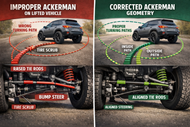
Understanding the Ackerman Effect: How Lifted Ride Heights Influence Steering Geometry and How to Fix It
Posted by Flatout Tech on Jan 14th 2026
When you lift a vehicle, you expect changes in suspension travel, center of gravity, and overall handling. What most people don’t expect is a change in how their front wheels turn relative to each other. This is where the Ackerman effect enters the picture. It is one of the most important steering geometry principles in any vehicle, and it becomes even more critical when modifying suspension height on platforms like Subaru Outback, Forester, Crosstrek, Honda Element, Toyota RAV4, and other common Flatout Suspension customers.
This article breaks down what Ackerman geometry is, why lifting disrupts it, and how to correct the problem for proper steering feel, reduced tire wear, and predictable cornering both on-road and off-road.
What Is the Ackerman Effect and Why Does It Matter?
When a vehicle turns, the inside tire must follow a tighter turning radius than the outside tire. Because of that, the inside wheel needs to steer at a sharper angle. Ackerman steering geometry is the built-in design that makes this happen. Without it, your front tires fight each other during a turn.
Ackerman helps with:
-
smoother low-speed steering
-
reduced tire scrub
-
better tire life
-
more predictable handling
-
easier maneuvering on trails
In a perfect world, if you extend the tie rod lines outward, they intersect at a point near the rear axle. This ensures that during a turn, both front tires are pointing along their correct turning circles.
Most factory vehicles are designed with positive Ackerman for street stability and drivability.
Why Ride Height Alteration Changes Ackerman Geometry
Ackerman geometry is built into the steering arms, rack position, and knuckle design. That part does not change. What does change when you lift or drastically lower a vehicle is the 3D relationship between the steering rack and the steering arms.
Ride height alters:
-
Tie rod angle
-
Steering rack vertical position relative to the knuckle
-
Bump steer curve
-
Dynamic toe during suspension travel
When you raise the vehicle, the tie rods angle downward toward the knuckle. This changes the arc the steering follows as the suspension moves through compression and droop. As a result, the actual steering behavior can shift away from the intended Ackerman curve.
Symptoms of altered Ackerman caused by lifting
Drivers often notice:
-
tire scrub in tight turns
-
heavier steering feel at low speeds
-
“pushing” or “plowing” sensation when parking
-
inconsistent steering response on uneven surfaces
-
more inside edge front tire wear
-
poor return-to-center
-
unpredictable corner entry on pavement
Even if the car tracks straight on the highway, incorrect Ackerman during turning can make a lifted vehicle feel nervous or imprecise.
Breaking Down the Root Cause: Tie Rod Geometry
The key issue is that tie rods are no longer aligned with the steering arm plane. On many vehicles, lifting raises the chassis relative to the knuckle, which tilts the tie rods downward. This causes a few problems:
1. Changes in the instant center of steering
When the tie rod and steering arm are no longer in the intended plane, the effective arc of steering changes. That can push the geometry toward reduced Ackerman or even anti-Ackerman in tight turns.
2. Increased bump steer
With the tie rod angled downward, any suspension movement now adds unintended toe-in or toe-out. Since both wheels are not toeing equally, this shifts the effective Ackerman while the vehicle is cornering or articulating.
3. Steering rack offset relative to knuckle
Raising the body increases vertical separation, which misaligns the original Ackerman intersection point. Even though the knuckle and steering arm didn’t change, the path the tie rod follows did.
How to Fix Ackerman Issues After Lifting a Vehicle
There is no single magic cure. Instead, the fix comes from restoring tie rod geometry and aligning the steering behavior back toward the factory design intention.
Here are the practical solutions.
1. Install Tie Rod Spacers or Adjustable Outer Tie Rod Ends
These components bring the tie rod angle back closer to stock by raising the outer joint height. This reduces bump steer and helps restore the correct Ackerman curve.
-
Short lifts may only need a small spacer
-
Larger lifts benefit from an adjustable-height outer joint
Flatout Suspension customers with 1–3 inch lifts see the most improvement with this correction.
2. Reposition the Steering Rack (When Possible)
Some platforms allow the steering rack to be shimmed downward to realign with the knuckle. This is rare on modern unibody SUVs but is common in motorsport or older trucks.
Bringing the rack closer to its original plane greatly improves dynamic toe and Ackerman behavior.
3. Use Correct-Length Lower Control Arms or Corrected Geometry Arms
On vehicles that gain significant track width when lifted due to suspension droop angle, the distance between the tie rod ends and the ball joints changes. This shifts the Ackerman characteristics.
Aftermarket control arms designed for lifted geometry can solve:
-
tie rod length mismatch
-
track width distortion
-
steering arm misalignment
4. Recalibrate Toe Settings With Lifted Geometry in Mind
Lifted vehicles should rarely use the exact factory toe specification, because the bump steer curve has shifted.
A small toe-out setting can improve turn-in feel and help straighten out uneven Ackerman results. Off-road rigs with high articulation often run a different toe curve than pavement cars.
Alignment should always be done with weight on wheels and at full final ride height.
5. Choose Lift Kits Designed With Geometry Correction in Mind
A properly engineered suspension lift considers that raising the body affects multiple systems, not just spring length. Flatout Suspension coilovers and strut lifts are built with corrected travel and geometry ranges in mind to minimize these issues.
This includes:
-
controlled tie rod angle
-
balanced camber gain
-
corrected droop limits
-
optimized compression stroke
Using a lift system built around full geometry balance reduces how much Ackerman correction is needed afterward.
Conclusion
The Ackerman effect is one of the most important steering geometry principles in any vehicle. When you lift a car or SUV, the changes in tie rod angle, rack height, and dynamic toe can distort the intended Ackerman curve. The result is steering that feels heavy, unpredictable, or uneven in turns.
Fortunately, the fix is straightforward:
-
restore tie rod alignment
-
reduce bump steer
-
correct toe settings
-
select parts designed for lifted geometry
-
use lift systems engineered to preserve steering behavior
Flatout Suspension lift kits are designed with proper geometry considerations so you get the travel and ground clearance you want without giving up steering predictability or safety.